
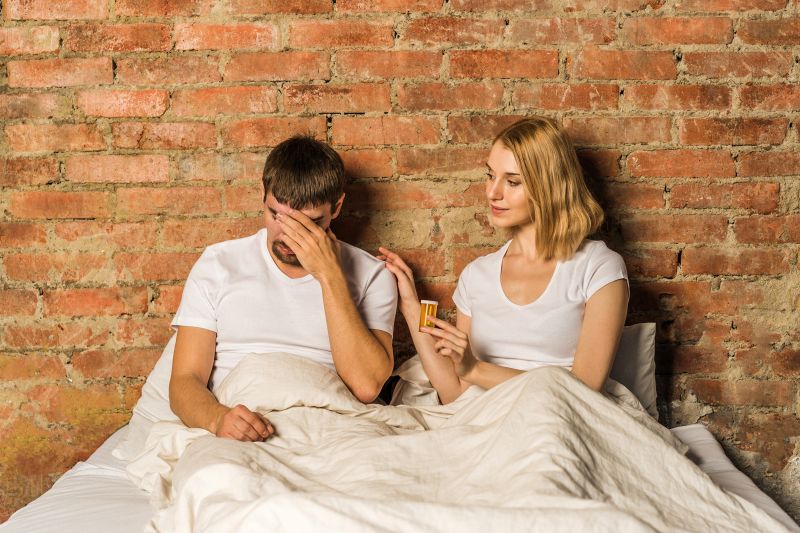
Apomorphine is a medication typically used for treating “off” episodes of Parkinson’s disease. It works by activating dopamine receptors in the brain, helping to replace or mimic the effects of natural dopamine. Since dopamine plays a role in sexual arousal, apomorphine could potentially influence one’s desire and libido, as well as help with stimulating erections.
This medication used to be approved by the U.S. Food and Drug Administration (FDA) for use with erectile dysfunction treatment (ED), but has since only been approved for use with Parkinson’s. However, recent clinical trials have sparked interest in reconsidering the drug for ED.
Does Apomorphine Work?
Between 2000-now, studies have shown small-dose (2-4 mg) apomorphine tablets placed under the tongue (sublingually) or doses administered by injection can be effective at helping with successful erections within 20 minutes for around half of the men studied. This is considerably faster than traditional PDE5 inhibitors such as Viagra or Cialis, which typically take around an hour to be effective. There has also been at least one study about a nasal spray version, but this proved to be less effective.
Research has also explored apomorphine’s effects beyond erectile function. In female patients experiencing hyposexual desire disorder (HSDD), which causes low levels of sexual desire, apomorphine appeared to help improve symptoms. This effect is thought to be related to dopamine stimulation in the brain, which is known to influence motivation and sexual interest. Interestingly, this likely links to the warnings found on Parkinson’s disease-related drugs detailing certain impulse control issues associated. According to this study, there were the same side-effects for women as there were for men.
Nevertheless, there has been very limited evidence to support an increase in libido or desire in male patients. While dopamine stimulation may influence impulse control, the mechanism may be ineffective in some ED patients, which is consistent with many clinical trials.
Specifically, apomorphine may be less effective for men with diabetes, men who have had a radical prostatectomy (a surgery to treat prostate cancer by removing the prostate), or older men with heart problems.
How Safe is Apomorphine?
An older review of apomorphine for use with ED stated that it can be considered as a treatment when the “gold standard” (PDE5 inhibitors) treatments have not been working for the patient.
Additionally, apomorphine may be offered for men being treated for cardiovascular issues, such as chest pain. This is because the nitrates in these heart medications do not interact well with traditional PDE5 inhibitors, and apomorphine has been proven to be safe with certain heart medications.
Side effects include:
- Dry mouth/irritation or skin tears near mouth
- Runny nose
- Chest tightness/fast heartbeat
- Dizziness, general weakness, or falling
- Fever, itchiness/hives, joint pain
- Redness or swelling near mouth
- Hoarse speech
- Trouble breathing or swallowing
Key Takeaways
- Apomorphine is traditionally used to treat Parkinson’s disease but has been used for erectile dysfunction in the past.
- Typically, it is taken as a tablet which dissolves under the tongue and has been provided as an injection or nasal spray.
- Though potentially less effective, apomorphine could be considered as a second option to PDE5 inhibitors like Viagra or Cialis. They should not be taken together.
- More research is needed to confirm if apomorphine should be prescribed for ED as well as Parkinson’s.
Resources
Altwein, J. E., & Keuler, F. U. (2001). Oral treatment of erectile dysfunction with apomorphine SL. Urologia Internationalis, 67(4), 257–263. https://doi.org/10.1159/000051001
Briganti, A., Chun, F. K., Salonia, A., Zanni, G., Deh??, F., Barbieri, L., Karakiewicz, P. I., Rigatti, P., & Montorsi, F. (2006). A comparative review of apomorphine formulations for erectile dysfunction. Drugs & Aging, 23(4), 309–319. https://doi.org/10.2165/00002512-200623040-00004
Caruso, S., Agnello, C., Intelisano, G., Farina, M., Di Mari, L., & Cianci, A. (2004). Placebo-controlled study on efficacy and safety of daily apomorphine SL intake in premenopausal women affected by hypoactive sexual desire disorder and sexual arousal disorder. Urology, 63(5), 955–959. https://doi.org/10.1016/j.urology.2003.12.018
Guillén, V., Rueda, J.-R., Lopez-Argumedo, M., Solà, I., & Ballesteros, J. (2020). Apomorphine for the treatment of erectile dysfunction: Systematic review and meta-analysis. Archives of Sexual Behavior, 49(8), 2963–2979. https://doi.org/10.1007/s10508-020-01817-5
Mohee, A., Bretsztajn, L., & Eardley, I. (2012). The evaluation of apomorphine for the treatment of erectile dysfunction. Expert Opinion on Drug Metabolism & Toxicology, 8(11), 1447–1453. https://doi.org/10.1517/17425255.2012.727797
Montorsi, F. (2002). The role of Apomorphine SL in the treatment of erectile dysfunction. European Urology Supplements, 1(3), 4–11. https://doi.org/10.1016/s1569-9056(02)00008-8
Mulhall, J. P., Bukofzer, S., Edmonds, A. L., & George, M. (2001). An open-label, uncontrolled dose-optimization study of sublingual apomorphine in erectile dysfunction. Clinical Therapeutics, 23(8), 1260–1271. https://doi.org/10.1016/s0149-2918(01)80105-3
National Institutes of Health. (n.d.). DailyMed - apomorphine hydrocloride- apomorphine hydrochloride injection. U.S. National Library of Medicine. https://dailymed.nlm.nih.gov/dailymed/drugInfo.cfm?setid=aedf70e4-1949-44bc-bf1b-0f282c4f0705
National Institutes of Health. (n.d.-b). DailyMed - ONAPGO- apomorphine hydrochloride injection, solution. U.S. National Library of Medicine. https://dailymed.nlm.nih.gov/dailymed/drugInfo.cfm?setid=f3552b6e-5ae7-4993-aa1a-e399c4a7080a
U.S. National Library of Medicine. (n.d.). Apomorphine sublingual: Medlineplus Drug Information. MedlinePlus. https://medlineplus.gov/druginfo/meds/a620044.html
You may also be interested in...
SMSNA Patients
Using the “Good Enough Sex” Model to Treat Female Sexual Interest/Arousal Disorder
March 5, 2024SMSNA
Defining and Diagnosing Female Sexual Interest/Arousal Disorder
August 14, 2023Blog
HSDD: I Have No Sexual Desire, What Can I Do About It?
September 26, 2023SMSNA Patients
Does the Menstrual Cycle Impact Sexual Desire?
July 25, 2023SMSNA Patients
Female Reddit Users Describe Their Experiences With Low Libido
April 18, 2023Did You Know?
The Effects of Nursing on a New Mother’s Sexuality
May 2, 2023Did You Know?
How and Why a Woman’s Libido Shifts During Pregnancy
March 23, 2023Blog
How Can Depression Affect Your Sex Drive?
February 2, 2023Blog
What Are Some Ways a Person Can Enhance Sexual Desire?
June 7, 2022Other Popular Articles
What Is the Average Penis Size?
If you have ever wondered how your penis compares to others in terms of size, you are not alone. Many men are curious to know how their penises stack up compared to the average. Unfortunately, general curiosity can sometimes give way to full-on obsession and anxiety about penis size. This can be an unhealthy and often unnecessary fixation, especially because most men who think their penises are too small have perfectly normal-sized penises.
Can Sex Reduce Menstrual Cramps?
The SMSNA periodically receives and publishes ‘guest editorials.’ The current article was submitted by Mia Barnes, a freelance writer and researcher who specializes in women's health, wellness, and healthy living. She is the Founder and Editor-in-Chief of Body+Mind Magazine.
Having sex while you experience menstrual cramps is healthy and can provide significant benefits. While it might not be the first activity that comes to mind when your PMS or period cramping begins, many people enjoy sex to reduce menstrual cramps, experience increased pleasure and benefit from other advantages. Learn more about having sex while menstrual cramps are happening and how it can help your body.

What Is Sensate Focus and How Does It Work?
Sensate focus is a technique used to improve intimacy and communication between partners around sex, reduce sexual performance anxiety, and shift away from ingrained, goal-oriented sexual patterns that may not be serving a couple.

What Is Jelqing, and Does It Actually Work?
The term “jelqing” refers to a set of penis stretching exercises that some believe can make the penis bigger. Although the practice has gained attention and popularity in blogs and internet forums in recent years, there is no scientific evidence that it is an effective way to permanently increase the size of one’s penis. In fact, in some cases, jelqing may actually cause damage to the penis, so it is a good idea to get all the facts before setting off to try it.

How Long Does It Take the Average Man to Ejaculate?
On average, it takes a man between 5 to 7 minutes to orgasm and ejaculate during sexual intercourse.
Can Sex Throw off Your Vaginal pH Balance?
The SMSNA periodically receives and publishes ‘guest editorials.’ The current article was submitted by Mia Barnes, a freelance writer and researcher who specializes in women's health, wellness, and healthy living. She is the Founder and Editor-in-Chief of Body+Mind Magazine.
Your vagina is a pretty powerful organ. It is a pathway for menstrual blood and babies. It also is a main player in sexual intercourse. You might hear about your vagina’s pH and worry that yours is at risk. Here’s what to know about vaginal pH, including the impacts sex could have.
Attention: Restrictions on use of SMSNA content in third party applications, including artificial intelligence technologies, such as large language models and generative AI.
You are prohibited from using or uploading content you accessed through this website into external applications, bots, software, or websites, including those using artificial intelligence technologies and infrastructure, including deep learning, machine learning and large language models and generative AI.