
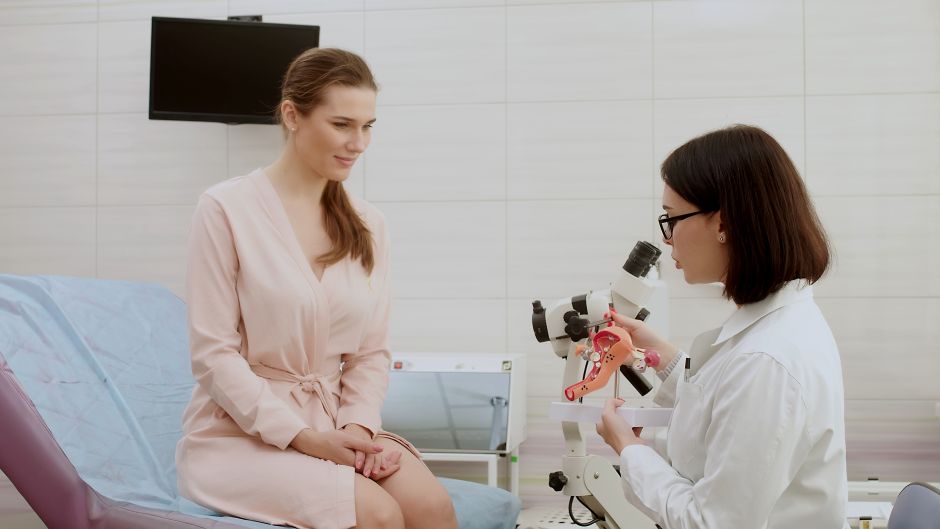
The best way to care for your cervix starts with learning all about it. The cervix is about an inch long and located 3-6 inches from the vaginal opening, depending on menstrual cycles and hormone changes. This tube-like structure is essential for reproduction because it allows microscopic sperm to enter the uterus, while protecting it from harmful bacteria and foreign objects. During childbirth, the cervix shortens to allow for easier labor.
There are two types of cells found in the cervix. Glandular cells, which support the production of protective mucus and natural lubricant; and squamous cells, which protect the cervix and uterus from friction, infection, and vaginal dryness.
The Importance of Pap Smears
Once a woman hits 21 (US Standard) they are often urged to begin regular Pap smears, which sweep the inside of the cervix to test these cell types. This is an essential part of cervical healthcare; it is a way to check to see if the cells are behaving normally. If the test comes back abnormal, this could be because of a variety of things, but the main thing your healthcare provider will be concerned about is human papillomavirus (HPV) and cervical cancer.
Cervical cancer is the fourth most common cancer amongst women globally, and is mostly caused by HPV, which is a sexually transmitted infection (STI), but is not always as dangerous as it sounds, depending on the strain of HPV (20/130 strains are cancer-related). If HPV is treated right away, the risk of cancer is much lower. Additionally, the abnormal cells may reveal cervical dysplasia, which is what happens before cervical cancer and looks like rapid cell growth.
Luckily, not all abnormal Pap smears mean one of these things. An abnormal result could be from hormonal changes (time of period cycle), recent sexual activity, or even the type of birth control someone is taking. It’s likely that a gynecologist may invite their patient back to the office a year later for a second Pap smear to confirm if the abnormal cells are persistent.
Non-Cancerous Cervical Conditions
Other conditions that could affect the cervix are polyps, fibroids, or cysts. These are usually undetectable until a routine pelvic exam and are usually non-cancerous growths that can be removed pretty easily in a clinic setting. Polyps are the most common of these three conditions, and may present with abnormal vaginal bleeding, but symptoms may not always show.
Cervicitis appears to be a catchall term for inflammation of the cervix. This can be caused by certain STIs, or by foreign objects, such as sexual aids and certain contraceptive measures, like condoms. Typically, cervicitis is treated with antibiotics for any STIs.
Some pregnancy-related cervical conditions can affect labor and delivery. Placenta previa happens when the placenta (organ that helps feed a fetus) partly or completely blocks the cervical entrance, often resulting in a cesarean delivery (c-section).
Another pregnancy complication may be cervical insufficiency, which causes the cervix to open too early, which may result in miscarriage or premature birth. Management for cervical insufficiency may include progesterone gel for the vagina, in order to trick the cervix into behaving appropriately.
Finally, while rare, cervical pregnancies can occur. This is when an egg implants in the cervix instead of the uterus. This pregnancy cannot continue without risking life-threatening hemorrhage (extreme blood loss).
Steps to Take for Cervical Care
There are certain basic steps that women can take to care for their cervix:
- Regular pelvic exams and Pap smears (recommended every 5 years beginning at age 21 in the US, unless a healthcare provider says otherwise).
- These may also include HPV screening, if abnormal results are frequent.
- Ask a healthcare provider for the HPV vaccine. This is recommended for college-aged patients (between 18-21) as they may be more likely to get HPV. The vaccine usually comes in three doses, a few months apart and is currently one of the best defenses against HPV and cervical cancer.
- This vaccination may also be offered to minors as young as 9 years old as a preventative measure, and can be recommended through age 26, with some individuals being recommended the vaccine through age 45.
- Practice safe sex using barrier methods. Condoms, diaphragms, and other devices are not only effective in preventing unwanted pregnancies, they are also effective at lowering the risk of STIs, including HPV.
- Avoid tobacco products. Tobacco products can contribute toward cancer growth.
If Pap smears frequently come back as abnormal, gynecologists may begin the process of testing for cancer, and treating cancer if necessary:
- Loop electrosurgical excision procedure (LEEP), which involves electricity and a metal loop to scrape away the abnormal cells and avoid further growth. This also allows for care teams to test the cells for cancer.
- If cancer is found, then the normal course of action is radiation, cryotherapy, and chemotherapy.
Key Points
- Preventative cervix care is important and easy, beginning around the age of 21 in the US.
- Be sure to speak with your healthcare provider about the best ways to care for your cervix.
Resources
Alkilani YG, Gomez Lopez LF, Apodaca-Ramos I. Cervical Polyps. [Updated 2025 May 29]. In: StatPearls [Internet]. Treasure Island (FL): StatPearls Publishing; 2025 Jan-. Available from: https://www.ncbi.nlm.nih.gov/books/NBK562185/
Anderson-Bagga FM, Sze A. Placenta Previa. [Updated 2023 Jun 12]. In: StatPearls [Internet]. Treasure Island (FL): StatPearls Publishing; 2025 Jan-. Available from: https://www.ncbi.nlm.nih.gov/books/NBK539818/
Binder, U., Wenzl, A., Lafleur, J., Tempfer, C., & Hefler, L. (2025). Loop electrosurgical excision procedure (LEEP) under Local Anesthesia: A retrospective analysis of 435 subsequent cases under a Quality Assurance Program. Archives of Gynecology and Obstetrics, 312(2), 621–625. https://doi.org/10.1007/s00404-025-08060-0
Centers for Disease Control and Prevention. (2021, November 16). HPV vaccination recommendations. Centers for Disease Control and Prevention. https://www.cdc.gov/vaccines/vpd/hpv/hcp/recommendations.html
Cooper DB, McCathran CE. Cervical Dysplasia. [Updated 2023 Jul 10]. In: StatPearls [Internet]. Treasure Island (FL): StatPearls Publishing; 2025 Jan-. Available from: https://www.ncbi.nlm.nih.gov/books/NBK430859/
Fowler JR, Maani EV, Dunton CJ, et al. Cervical Cancer. [Updated 2023 Nov 12]. In: StatPearls [Internet]. Treasure Island (FL): StatPearls Publishing; 2025 Jan-. Available from: https://www.ncbi.nlm.nih.gov/books/NBK431093/
Iqbal U, Carlson K, Wills C. Cervicitis. [Updated 2025 Jan 21]. In: StatPearls [Internet]. Treasure Island (FL): StatPearls Publishing; 2025 Jan-. Available from: https://www.ncbi.nlm.nih.gov/books/NBK562193/
Thakur M, Jenkins SM, Mahajan K. Cervical Insufficiency. [Updated 2024 Oct 6]. In: StatPearls [Internet]. Treasure Island (FL): StatPearls Publishing; 2025 Jan-. Available from: https://www.ncbi.nlm.nih.gov/books/NBK525954/You may also be interested in...
Blog
What to Know About HPV Transmission and Prevention
July 16, 2026Did You Know?
I have Vulvar Cancer, Now What?
May 26, 2026SMSNA
Common Urological Skin Conditions
September 16, 2026Did You Know?
What is a LEEP, and How Might It Affect Sexual Health?
February 25, 2025Did You Know?
What Is a Colposcopy, and What Should I Expect?
May 28, 2024Blog
What Is the Role of the Cervix in Sexual Response?
February 28, 2023Other Popular Articles

What Is the Average Penis Size?
If you have ever wondered how your penis compares to others in terms of size, you are not alone. Many men are curious to know how their penises stack up compared to the average. Unfortunately, general curiosity can sometimes give way to full-on obsession and anxiety about penis size. This can be an unhealthy and often unnecessary fixation, especially because most men who think their penises are too small have perfectly normal-sized penises.
Can Sex Reduce Menstrual Cramps?
The SMSNA periodically receives and publishes ‘guest editorials.’ The current article was submitted by Mia Barnes, a freelance writer and researcher who specializes in women's health, wellness, and healthy living. She is the Founder and Editor-in-Chief of Body+Mind Magazine.
Having sex while you experience menstrual cramps is healthy and can provide significant benefits. While it might not be the first activity that comes to mind when your PMS or period cramping begins, many people enjoy sex to reduce menstrual cramps, experience increased pleasure and benefit from other advantages. Learn more about having sex while menstrual cramps are happening and how it can help your body.

What Is Sensate Focus and How Does It Work?
Sensate focus is a technique used to improve intimacy and communication between partners around sex, reduce sexual performance anxiety, and shift away from ingrained, goal-oriented sexual patterns that may not be serving a couple.
What Is Jelqing, and Does It Actually Work?
The term “jelqing” refers to a set of penis stretching exercises that some believe can make the penis bigger. Although the practice has gained attention and popularity in blogs and internet forums in recent years, there is no scientific evidence that it is an effective way to permanently increase the size of one’s penis. In fact, in some cases, jelqing may actually cause damage to the penis, so it is a good idea to get all the facts before setting off to try it.

How Long Does It Take the Average Man to Ejaculate?
On average, it takes a man between 5 to 7 minutes to orgasm and ejaculate during sexual intercourse.

Can Sex Throw off Your Vaginal pH Balance?
The SMSNA periodically receives and publishes ‘guest editorials.’ The current article was submitted by Mia Barnes, a freelance writer and researcher who specializes in women's health, wellness, and healthy living. She is the Founder and Editor-in-Chief of Body+Mind Magazine.
Your vagina is a pretty powerful organ. It is a pathway for menstrual blood and babies. It also is a main player in sexual intercourse. You might hear about your vagina’s pH and worry that yours is at risk. Here’s what to know about vaginal pH, including the impacts sex could have.
Attention: Restrictions on use of SMSNA content in third party applications, including artificial intelligence technologies, such as large language models and generative AI.
You are prohibited from using or uploading content you accessed through this website into external applications, bots, software, or websites, including those using artificial intelligence technologies and infrastructure, including deep learning, machine learning and large language models and generative AI.